
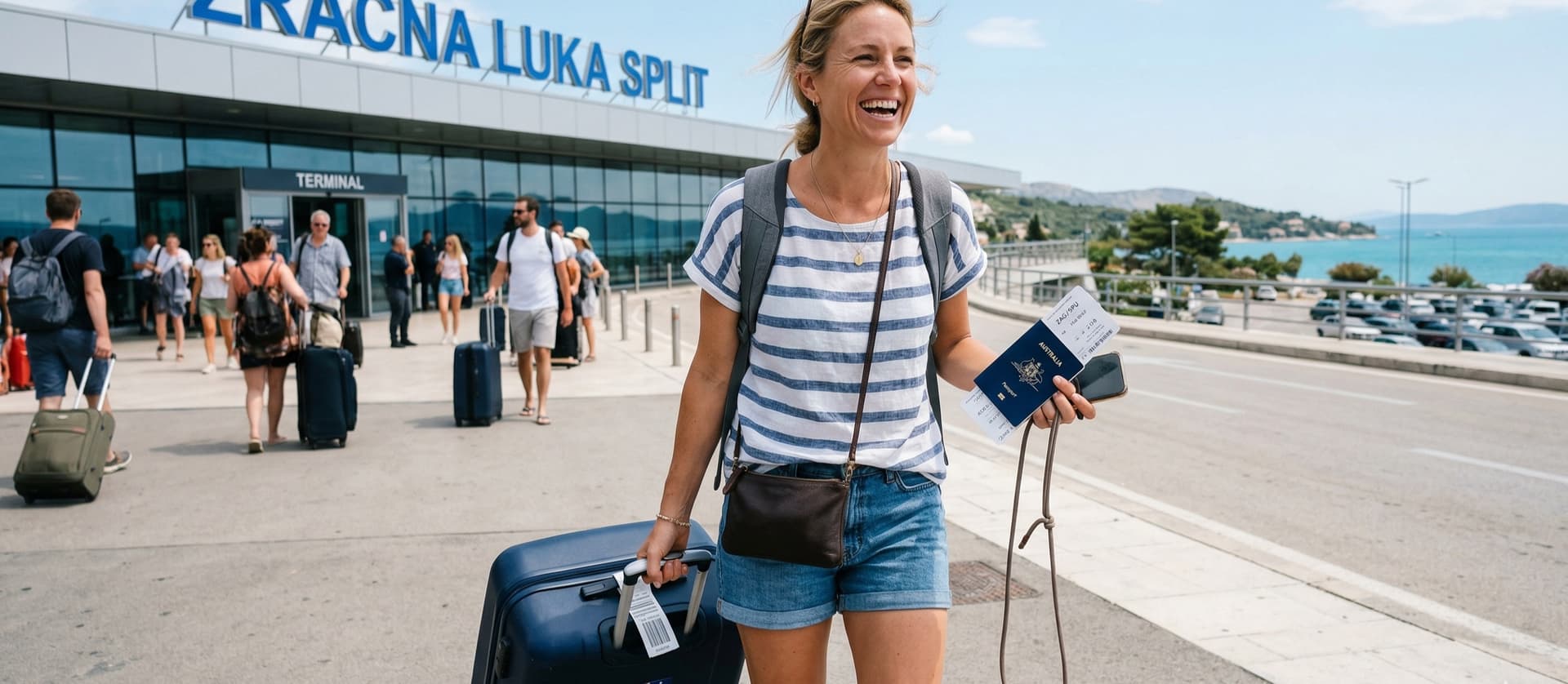
From Australia to Split: One Family's Croatian Citizenship Journey
Three generations, two continents, and one goal: reclaiming Croatian citizenship. Ana Petrović shares her family's story of paperwork, emotions, and belonging.
Ana Petrović
Community Member · Published 20 February 2026 · Updated 24 March 2026
Privacy notice: To protect the author's identity in accordance with GDPR and applicable privacy regulations, "Ana Petrović" is a pseudonym. The photograph used in this article is a stock illustration and does not depict the actual author or her family.
My grandfather never talked about the day he left. Not really. He would talk about Split endlessly — the smell of fish at the Riva, the sound of klapa singers echoing off stone walls on summer evenings, the way the Marjan hill turned golden just before sunset. But the actual leaving, the boat, the goodbye at the harbour with his mother — that was a door he kept shut.
His name was Marko Petrović. He left Split in 1961, at twenty-three, with a suitcase and an address in Sydney written on a piece of paper. A cousin had gone the year before and wrote back that there was work at the Snowy Mountains Hydroelectric Scheme. So Marko went. He didn't know it would be permanent. Nobody ever does.
I grew up in Melbourne. My name is Ana. I'm a physiotherapist, I'm thirty-four, and as of November 2025, I am a Croatian citizen. This is the story of how that happened.
Growing up Croatian in Melbourne
My father, Ivan, was born in Sydney in 1966. He grew up speaking Croatian at home and English everywhere else. By the time I came along in 1992, the Croatian was diluted — Dad spoke it with Grandpa Marko but not with me, and my mother, who is Australian-born of English and Irish stock, didn't speak it at all.
What we did have was the culture. We went to the Croatian Club in Footscray. We ate sarma at Christmas and peka on special occasions. We went to mass at the Croatian Catholic Centre in St Albans. I grew up knowing I was Croatian in the way you know you have brown eyes — it was simply a fact about yourself, not something you thought about critically.
Grandpa Marko died in 2018. He was eighty. He never went back to Croatia, not once. He always said he would, but there was always a reason not to — money, work, the war, his health. When he died, we found his Croatian birth certificate in a shoebox along with a few black-and-white photographs and a letter from his mother, dated 1963, that he had never translated for any of us.
I had it translated a year later. It said: Come home when you can. The figs are good this year.
That was when I started thinking seriously about citizenship.
The moment it clicked
I'd vaguely known for years that descendants of Croatian emigrants could apply for citizenship. But I assumed there were catches — a language test, a residency requirement, a generational cutoff. I'd read contradictory things online: one forum post said you needed to speak fluent Croatian, another said the law had changed but only for people whose ancestors left before World War II.
In early 2025, I came across Croatian Roots while searching for something else entirely. I took their eligibility check on a whim, mostly to confirm that I didn't qualify, so I could stop thinking about it.
The result said I almost certainly did.
I sat at my kitchen table in Northcote and stared at my phone for a while. Then I called my dad.
What the law actually says
Here's what I learned, and what I wish someone had told me ten years earlier:
Under Article 11 of the Croatian Citizenship Act, descendants of people who emigrated from Croatian territory before 8 October 1991 can apply for citizenship by descent. There is no generational limit — it doesn't matter whether you're the child, grandchild, or great-grandchild of the emigrant. There is no language test for descent-based applicants (that requirement was removed in 2020). And Croatia fully permits dual citizenship, so I didn't have to give up my Australian passport.
My grandfather left Split in 1961. My father was born in Australia in 1966. I was born in Australia in 1992. Three generations — and all three of us were eligible.
Dad decided to apply at the same time.
The document trail
This was the hard part. Not because any single step was impossible, but because there were a lot of steps and they all had to be done in the right order.
The core of the application is proving an unbroken lineage from the Croatian ancestor to yourself. For me, that meant:
- Grandpa Marko's Croatian birth certificate — the original from the shoebox. Since it was issued in Croatia, it didn't need an Apostille and had no date limit. We just needed a certified copy from the registry office in Split.
- Grandpa Marko's death certificate — issued in Australia. Needed an Apostille from the Department of Foreign Affairs and Trade (DFAT) and a certified Croatian translation.
- My father's Australian birth certificate — long form, issued within 1.5 years of our appointment date. Apostille from DFAT, plus Croatian translation.
- My parents' marriage certificate — same deal. Long form, recent issue, Apostille, translation.
- My own birth certificate — same again.
- Police clearance certificate — the Australian equivalent of the FBI background check. Couldn't be older than six months. Apostille plus translation.
- Passport — valid Australian passport plus two photocopies of the photo page.
- CV in Croatian — one page, including my name, address, education, and employment.
- Motivational letter in Croatian — explaining my family connection, why I wanted citizenship, and my ties to Croatian culture.
- Obrazac 1 — the official application form, completed in Croatian.
- Proof of address — a utility bill. No translation needed.
Then everything had to be organized into two piles — originals in Pile 1, photocopies of everything in Pile 2 — stapled in a specific order: translator's cover letter, Croatian translation, Apostille, original document.
For my father, the pile was slightly different because he was one generation closer to Grandpa Marko, but he still needed all his own personal documents.
The part that surprised me
I expected the documents to be hard. I expected the translations to be expensive. What I didn't expect was the emotional weight of it.
Requesting Grandpa Marko's birth certificate from the registry office in Split meant engaging with a bureaucratic system in a country I'd never visited, in a language I barely understood, about a man who had been central to my childhood. When the certified copy arrived — Marko Petrović, rođen 14. veljače 1938., Split — I held a piece of paper that proved my grandfather had existed in a place I'd only ever heard about through stories.
Croatian Roots handled the archive research for us. They contacted the registry office in Split, retrieved the records, and coordinated the certified copies. It would have taken me months to navigate that on my own from Melbourne, and I'm not sure I would have known which office to contact or what to ask for.
The ship manifest was another moment. Grandpa Marko didn't come by plane — he sailed on the Toscana from Genoa to Sydney in March 1961. The manifest listed his name, age, nationality (Jugoslav), occupation (radnik — worker), and destination (Sydney, N.S.W.). Seeing his name on that list, one line among hundreds, a twenty-three-year-old heading into the unknown — I understood something about him that his stories had never quite conveyed.
The motivational letter
This was the document I dreaded most. How do you explain in a formal letter, in a language you don't speak, why you feel Croatian?
I wrote it in English first. I wrote about Grandpa Marko and the Croatian Club in Footscray. About sarma at Christmas and the way my father's face changes when he hears Moj lipi anđele on the radio. About the photographs in the shoebox and the letter about the figs. About wanting my future children to have something more than stories — to have a legal, documented, undeniable connection to the place our family comes from.
Croatian Roots translated it into Croatian for me as part of our service package. They also drafted my CV in Croatian. Those two documents alone would have cost a significant amount if I'd gone to a separate translator, so having them included was a relief.
The appointment
We flew to Canberra for the appointment at the Croatian Embassy. Dad and I went together. We brought our two piles each — four piles total — in a carry-on bag that I refused to check.
The consular officer was methodical and kind. She went through every document, checked every Apostille, verified every translation. It took about forty-five minutes per applicant. We signed our Obrazac forms in front of her. She verified our passports. We paid the application fee — $237.50 each — and she gave us a receipt and a reference number.
Walking out of the embassy, Dad didn't say anything for a while. Then he said: "Marko would have liked this."
The wait
After the appointment, the application was forwarded to the Ministry of Interior in Zagreb. We were told to expect 12–24 months for a decision.
Ours took fourteen months. In that time, the Ministry requested one additional document — a clarification about a minor discrepancy in Grandpa Marko's surname spelling between his Croatian birth certificate (Petrović) and his Australian death certificate (Petrovic, without the diacritic). Croatian Roots handled the response on our behalf through the power of attorney we'd signed as part of the Full Representation package.
The approval came by email on a Tuesday afternoon in November 2025. I was between patients at the clinic. I read it three times.
Going to Split
In January 2026, I went to Croatia for the first time. I flew into Zagreb, picked up my domovnica — my certificate of citizenship — and drove down to Split.
I will not pretend it was some cinematic homecoming. I didn't weep at the harbour or feel Grandpa Marko's ghost walking beside me. What I felt was quieter than that. I walked along the Riva and looked at the water and thought: this is where he used to sit. I found the building where he was born — or what I think was the building, based on the address on his birth certificate — and it was a normal apartment block with laundry hanging from the windows.
I ate pašticada at a restaurant near Diocletian's Palace. I climbed Marjan in the late afternoon and watched the sun drop toward the sea. I thought about figs.
It wasn't a homecoming. It was a beginning.
What I'd tell someone considering it
If you have Croatian ancestry and you've been putting it off — because it seems complicated, because you think there's a generational limit, because you heard you need to speak Croatian — stop putting it off.
The law is on your side. There is no generational limit. There is no language test. You do not have to give up your current passport. The process is real work — it took us about eighteen months from the first phone call to the approval — but it is absolutely doable, especially if you have professional help.
The documents are the hard part, and they are hard mostly because there are many of them and they all have specific rules. Get the order right: map your family chain first, then gather documents, then Apostilles, then translations. Don't translate before you have the Apostille — you'll end up paying twice.
And if you're not sure whether you qualify, just take the eligibility check. It takes two minutes. That's how I started, sitting at my kitchen table, expecting to be told no.
I was told yes. And now I have a Croatian passport, an EU passport, and a connection to a place that my grandfather carried with him for sixty years across the ocean but could never quite bring himself to go back to.
I went back for him.
Croatian heritage? You may already be a citizen.
If you have Croatian ancestry, you may be entitled to a passport — regardless of how many generations removed you are. Find out in two minutes.
Check My Eligibility — Free